Choosing the right filter press feed pump is one of the most consequential decisions in any filtration project — and one of the most frequently misunderstood. Buyers often pick a pump based on catalog flow rate alone, only to discover weak final pressure, wet filter cake, and frustratingly long cycle times. The solution starts with understanding that a feed pump’s job changes minute by minute throughout every filtration cycle.
UN filter press feed pump must deliver high flow at the start of the cycle to fill chambers quickly, then transition to high pressure at very low flow as filter cake builds and resistance rises. No single pump specification captures both demands equally. The best selection approach matches the pump to the slurry, the press, and the full operating curve — not just a single rated data point.
Below, I’ll walk through what a feed pump actually does during a press cycle, compare the four most common pump types, explain the critical sizing factors, and show why dual-pump configurations often outperform a single unit. I’ll also share the most common mistakes we see buyers make after more than 20 years of manufacturing filter presses.
What Does a Filter Press Feed Pump Actually Do?
Most people think of a feed pump as a simple slurry transfer device. It’s not. The filter press feed pump is the engine that drives the entire filtration cycle, and its performance profile must change dramatically from start to finish.
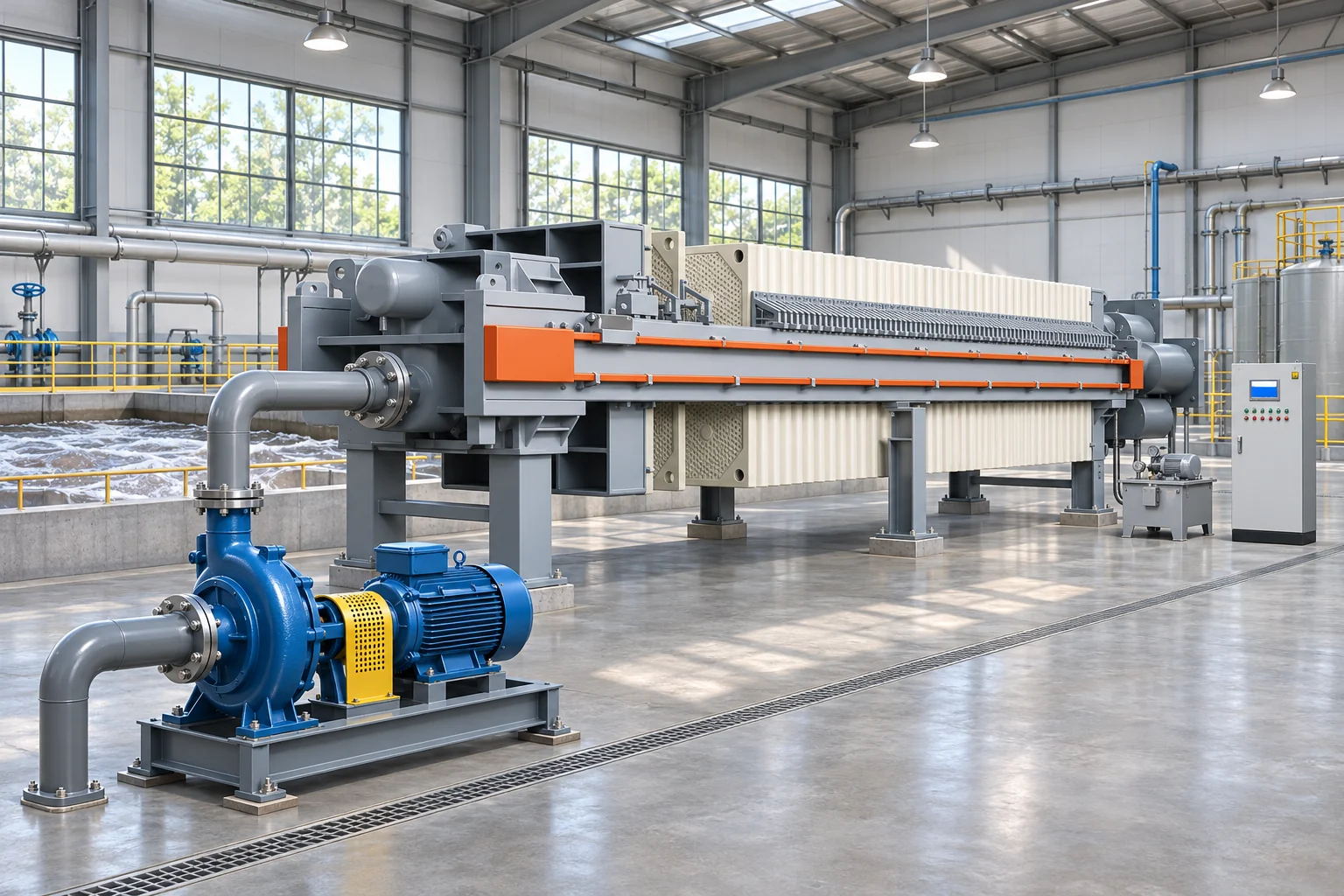
A filter press feed pump pushes slurry into the press chambers, forces liquid through the filter cloth, and compresses the forming cake — all in a single, continuous operation. Its role shifts from a high-volume filling device to a high-pressure compaction device within the same cycle.
The Two Phases of Every Feed Cycle
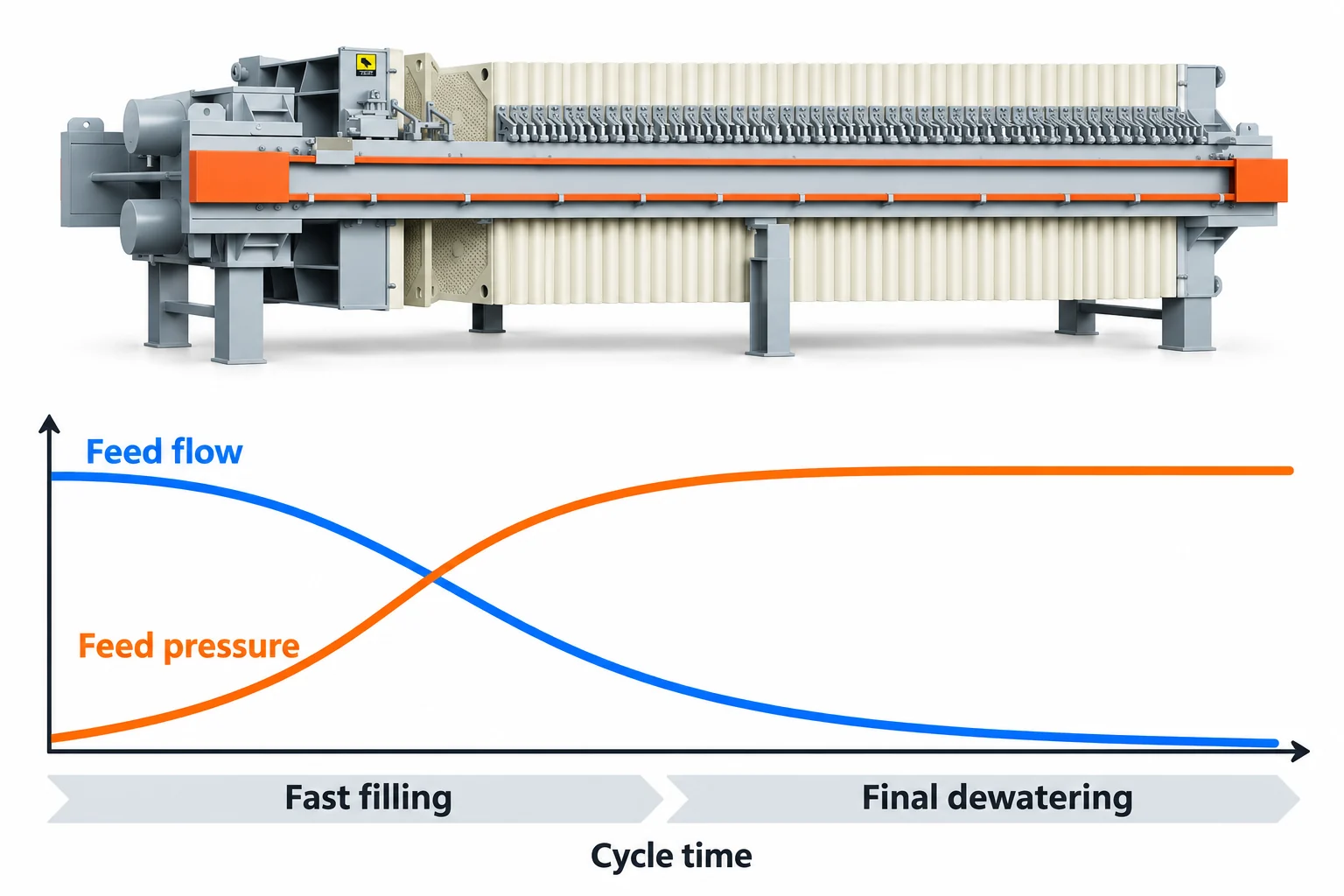
At the beginning of a cycle, the filter press chambers are empty. The pump faces minimal resistance, so it should deliver maximum flow to fill the chambers as fast as possible. Speed matters here — every minute of unnecessary filling time is wasted production capacity.
As slurry enters the chambers and filtrate drains through the cloth, a layer of solid cake begins forming on each plate surface. This cake acts as an increasingly dense filter medium. Resistance to flow rises steeply. The pump’s flow rate drops — sometimes to a trickle — while the required pressure climbs toward the press’s maximum operating pressure.
Why This Matters for Pump Selection
This dual-phase behavior means the pump must operate efficiently across a wide range of flow rates and pressures. A pump that delivers great flow at low pressure but cannot sustain high pressure at near-zero flow will produce:
- Wet, poorly dewatered cake — because the final compaction pressure was never reached
- Long cycle times — because the pump stalled or slowed excessively mid-cycle
- High energy consumption — because the pump ran inefficiently outside its design range
From our experience at LONGONE, matching the pump curve to the press’s chamber volume, operating pressure, and expected cake resistance is the single most important step in system design.
Types of Filter Press Feed Pumps: Centrifugal, Screw, Diaphragm and Piston Compared
Not all pumps handle the demands of filter press feeding equally. Choosing among centrifugal, screw, diaphragm, and piston pumps requires understanding how each type behaves across the full pressure-flow curve and how it interacts with the slurry.
The four main filter press feed pump types differ in pressure capability, flow behavior, wear resistance, and suitability for different slurry characteristics. Centrifugal pumps excel at high-flow filling but struggle at high pressure. Positive-displacement types (screw, diaphragm, piston) maintain pressure at low flow but come with trade-offs in cost, maintenance, and shear sensitivity.

Pump Type Comparison Table
| Feature | Centrifugal Pump | Screw Pump | Diaphragm Pump | Piston Pump |
|---|---|---|---|---|
| Pressure Range | Up to ~0.6 MPa | Up to ~1.2 MPa | Up to ~1.0 MPa | Up to ~6.0 MPa |
| Flow Behavior | High flow at low pressure; flow drops sharply as pressure rises | Steady flow across pressure range | Pulsating but consistent at high pressure | Pulsating, very consistent at high pressure |
| Suitable Slurry | Low-abrasion, non-shear-sensitive | Viscous, shear-sensitive slurries | Abrasive, corrosive, or shear-sensitive slurries | Highly abrasive, high-solids slurries (mining, minerals) |
| Shear Impact | High — can break flocs | Low | Very low | Low |
| Wear Resistance | Low to moderate | Moderate | High (elastomer diaphragm isolates internals) | High (hardened valves and pistons available) |
| Capital Cost | Low | Moderate | Moderate to high | High |
| Maintenance | Simple but frequent with abrasive slurry | Moderate — stator wear on abrasive feeds | Diaphragm replacement is routine | Higher — valves, seals, pistons |
| Best Role | Fast chamber filling; low-pressure applications | Medium-pressure feeding; viscous or sensitive sludge | General-purpose medium-to-high-pressure feeding | High-pressure final dewatering; mining applications |
Key Takeaways by Pump Type
- Centrifugal pumps are the most common starting point because of low cost and simplicity. However, their performance curve makes them a poor choice as a standalone feed pump for presses operating above 0.6 MPa. Flow drops to nearly zero as backpressure rises, which means the final dewatering phase is weak.
- Screw pumps (progressive cavity) offer a more linear pressure-flow relationship and handle viscous, shear-sensitive sludges well. The main weakness is stator wear when pumping abrasive solids — replacement intervals can be short in mining or mineral processing.
- Diaphragm pumps are popular for chemical, environmental, and food-industry filter press applications. The diaphragm isolates the drive mechanism from the slurry, providing good chemical resistance and gentle handling. Pulsation dampeners are often needed to smooth flow.
- Piston pumps are the heavy-duty option. They reach pressures well above what most other types can achieve and are standard in mining and mineral processing. They are also the most expensive and require the most maintenance.
Practical note: No single pump type is universally “best.” The right choice depends on your slurry, your press, and your operating pressure. I always recommend starting from the application, not the pump catalog.
Key Selection Factors: Pressure, Flow Rate and Slurry Characteristics?
Many procurement teams focus on rated flow rate when selecting a filter press feed pump. That number matters, but it’s only one piece of the puzzle. Pressure capability and slurry behavior often have a bigger impact on real-world performance.
The three critical selection factors are maximum operating pressure, flow rate at operating pressure (not just rated free-flow), and slurry characteristics including solids concentration, particle size, abrasiveness, and shear sensitivity. Getting any one of these wrong leads to underperformance.
Pressure: Match the Pump to the Press
A filter press rated for 1.0 MPa or higher cannot achieve its design dewatering performance if the feed pump maxes out at 0.6 MPa. This is one of the most common mismatches we encounter. The pump’s maximum sustained outlet pressure must meet or exceed the press’s rated filtration pressure.
- Presses for municipal sludge typically operate at 0.6–0.8 MPa
- Chemical and industrial presses often require 1.0–1.6 MPa
- Mining and mineral applications may need 1.6–6.0 MPa
Flow Rate: Read the Full Curve
Catalog flow rates are usually stated at zero or minimal backpressure. What matters is flow rate at your target operating pressure. Ask the pump supplier for a complete performance curve, and overlay it with the resistance curve of your filter press application.
Slurry Characteristics Checklist
| Slurry Property | Impact on Pump Choice |
|---|---|
| High solids concentration (>30%) | Needs positive-displacement pump; centrifugal pumps lose efficiency |
| Fine, compressible solids | Requires gradually rising, stable pressure — avoid pressure spikes |
| Coarse, abrasive particles | Demands hardened wetted parts; piston or lined diaphragm pump preferred |
| Flocculated sludge | Shear-sensitive — avoid high-speed centrifugal impellers |
| Corrosive or acidic slurry | Material compatibility critical — rubber-lined, plastic, or exotic alloys |
| High temperature (>60 °C) | Seal and elastomer ratings must match; metal pump bodies preferred |
The right approach is to start from the slurry and work outward to the pump type, then validate against the press’s requirements.
Why Filter Presses Need High Head and Low Flow at the End of the Cycle?
This question comes up repeatedly from buyers new to filter press systems. The short answer is physics: as filter cake thickness increases, hydraulic resistance increases exponentially, and the pump must overcome that resistance to force out the remaining moisture.
At the end of a filter press cycle, the chambers are nearly full of compacted solids. The remaining moisture is trapped inside the cake structure. Extracting it requires sustained high pressure at very low flow — often less than 5% of the initial flow rate. This final phase determines cake dryness, and it’s where many undersized pumps fail.
The Physics of Cake Resistance
As filtrate passes through the forming cake and the cloth, the relationship between pressure, flow, and resistance follows a pattern described by Darcy’s law. In simple terms:
- Early in the cycle: thin cake, low resistance, high flow
- Mid-cycle: cake grows, resistance increases, flow begins to fall
- End of cycle: thick cake, very high resistance, flow approaches zero
If the pump cannot maintain target pressure as flow drops to near zero, the cake stops compacting. The result is higher moisture content — sometimes 5–10 percentage points higher than what the press is designed to achieve.
What “High Head” Really Means
In pump terminology, “head” relates to the pressure a pump can generate. For filter press applications, buyers should focus on the pump’s ability to sustain its rated pressure continuously, even when flow rate is minimal. A pump rated at 1.0 MPa that overheats, cavitates, or stalls at low flow is not suitable — regardless of what the nameplate says.
From our production floor: We test every filter press at rated pressure before shipment. When customers provide pump curves during the quoting stage, we can verify compatibility and flag potential problems before anything ships. This step alone prevents many field issues.
Dual-Pump Configurations: Fast Filling Plus High-Pressure Dewatering?
If a single pump can’t excel at both high-flow filling and high-pressure dewatering, why not use two? Dual-pump configurations are increasingly common — and for good reason. They solve the fundamental mismatch between the two phases of a filter press cycle.
A dual-pump setup pairs a high-flow, lower-pressure pump (usually centrifugal) for fast chamber filling with a high-pressure, low-flow pump (diaphragm or piston) for final dewatering. The system switches automatically at a set pressure threshold. This approach saves energy, reduces pump wear, and produces drier cake.

How It Works in Practice
- Phase 1 — Fast Fill: The centrifugal pump runs at full capacity, filling the press chambers quickly. This phase typically accounts for 30–50% of total cycle time.
- Pressure switchover: When chamber backpressure reaches a preset level (e.g., 0.4–0.6 MPa), a control valve or PLC switches the feed to the high-pressure pump.
- Phase 2 — High-Pressure Dewatering: The positive-displacement pump takes over, gradually raising pressure to the press’s rated maximum while flow tapers off.
Benefits of Dual-Pump Systems
- Shorter cycle times: The centrifugal pump fills chambers faster than a positive-displacement pump can alone.
- Lower energy consumption: Each pump operates in its most efficient range.
- Reduced wear: The high-pressure pump doesn’t have to handle the high-volume, lower-concentration slurry in the early phase.
- Drier cake: Full rated pressure is achieved reliably, maximizing moisture extraction.
- Longer pump life: Both pumps spend less time in inefficient operating zones.
When Is a Single Pump Sufficient?
For smaller presses (filtration area under ~30 m²), low-pressure applications (≤0.6 MPa), or slurries that filter easily (coarse, incompressible solids), a single well-matched pump can work fine. The added complexity and cost of a dual-pump system is justified mainly for medium-to-large presses, high-pressure operation, or difficult slurries.
Common Feed Pump Mistakes and Maintenance Tips?
Even the right pump can underperform if it’s installed, piped, or maintained incorrectly. After shipping more than 3,000 filter presses, we’ve seen the same feed pump mistakes repeat across industries and continents.
The most common filter press feed pump mistakes are undersizing on pressure, oversizing on flow, ignoring slurry abrasiveness, and neglecting routine maintenance. Any one of these shortens pump life and degrades filtration performance.

Top Mistakes to Avoid
- Selecting on flow rate alone. A pump that delivers 100 m³/h at zero head but only 0.5 MPa at full load cannot serve a press rated for 1.0 MPa. Always check the full curve.
- Ignoring pipe sizing and layout. Undersized pipes, excessive elbows, and long runs add friction loss, reducing effective pressure at the press inlet. Size piping as part of the system, not as an afterthought.
- Using a centrifugal pump on flocculated sludge. High impeller speed breaks floc structure, releasing bound water and fine particles that blind the filter cloth. Use a low-shear pump instead.
- Skipping pulsation dampeners on diaphragm/piston pumps. Pressure pulsations stress filter plates, cloths, and piping joints. A dampener is not optional — it’s a system requirement.
- Running the pump dry. Even brief dry running can destroy seals and internal surfaces. Interlock the pump start with a slurry tank level sensor.
Maintenance Best Practices
| Maintenance Task | Frequency | Why It Matters |
|---|---|---|
| Inspect seals and packing | Weekly | Prevents leaks and slurry contamination of bearings |
| Check diaphragm condition (diaphragm pumps) | Every 500–1,000 hours | Diaphragm failure causes immediate loss of pressure |
| Inspect impeller/stator wear (centrifugal/screw) | Monthly | Worn components reduce flow and efficiency |
| Verify valve seating (piston pumps) | Every 500 hours | Worn valves cause pressure loss and backflow |
| Flush pump and piping after shutdown | Every cycle or daily | Prevents solids from hardening inside the pump |
| Review pressure and flow logs | Weekly | Catches gradual performance degradation before failure |
A personal observation: In our after-sales experience, the single best predictor of long pump life is whether the operator flushes the system after each cycle. It’s a five-minute task that prevents most emergency repairs.
Frequently Asked Questions
Can I use a centrifugal pump as the only feed pump for my filter press?
Yes, for low-pressure applications (below 0.6 MPa) with non-abrasive, non-flocculated slurries. For higher pressures or difficult materials, a centrifugal pump alone will struggle to deliver adequate end-of-cycle pressure, resulting in wetter cake and longer cycles.
How do I know if my feed pump is undersized?
The clearest signs are cycle times significantly longer than design, cake that is visibly wet or won’t release from the cloths, and the pump reaching its maximum pressure before the cake is fully formed. Reviewing the pump’s actual performance curve against your press’s requirements will confirm the mismatch.
What pressure should my feed pump reach for a standard filter press?
Most standard recessed-chamber filter presses operate between 0.6 and 1.6 MPa. The pump should be capable of reaching at least the press’s rated filtration pressure plus 10–15% for system losses. Membrane squeeze presses may require even higher feed pressures depending on the application.
Is a dual-pump system more expensive to maintain?
It adds a second set of wear parts and controls, but each pump operates within its optimal range — the filling pump runs at high flow for a short time, and the pressure pump runs at low flow for the remainder. In practice, total maintenance cost is often lower because neither pump is forced to operate outside its design envelope.
How does slurry temperature affect feed pump selection?
Higher temperatures reduce slurry viscosity, which can improve filtration rate but may also affect seal and diaphragm materials. For slurries above 60°C, verify that all wetted parts and seals are rated for the operating temperature. Heat-resistant elastomers and mechanical seals may be required.
Conclusione
Choosing the right filter press feed pump is not a catalogue exercise — it’s a system engineering decision. The pump must match your slurry’s properties, your press’s operating pressure, and the two-phase demand of every filtration cycle: high flow for filling, high pressure for dewatering. Centrifugal, screw, diaphragm, and piston pumps each have their place, and for the most demanding applications, a dual-pump configuration delivers the best combination of speed, cake dryness, and equipment longevity.
At LONGONE, we design and manufacture complete filter press systems — presses, plates, cloths, and ancillary equipment — and we work with customers daily to match feed pumps to specific applications. If you’re specifying a new system or troubleshooting an existing one, contact our engineering team for filter press and feed pump matching recommendations tailored to your slurry, throughput, and site conditions.